When you open a website, everything appears to happen instantly.
You click a button.
A page loads.
You log in to your account.
Photos appear.
Messages are sent.
Payments are processed.
Behind these simple actions is a combination of technologies working together.
Some parts of an application are responsible for everything you can see and interact with.
Other parts handle the processing, business logic, databases, and communication happening behind the scenes.
To make software easier to build and maintain, these responsibilities are typically divided into different areas of development.
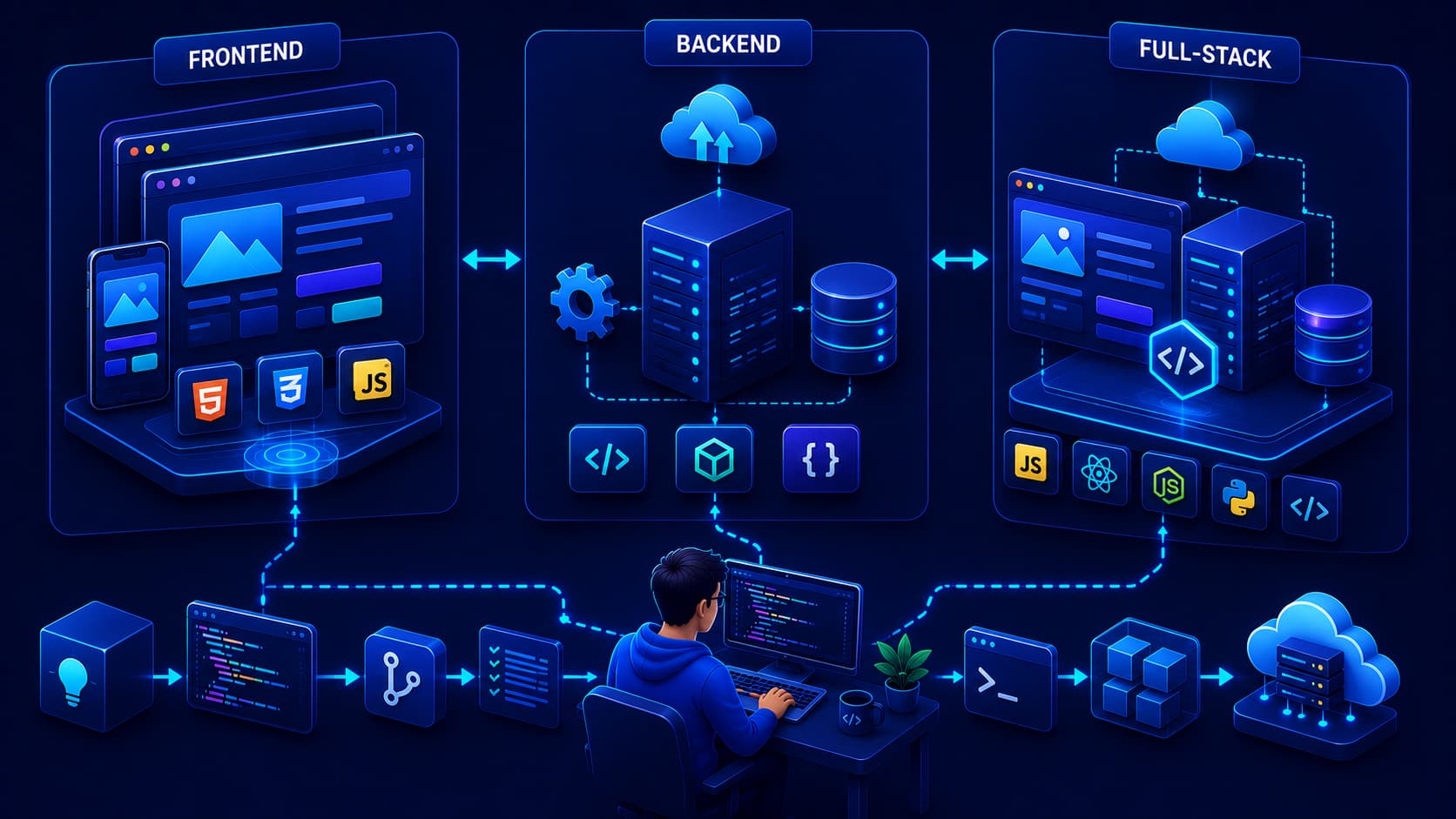
The most common roles are frontend development, backend development, and full-stack development.
Although each role has a different focus, they all contribute to building complete applications.
Understanding how they work together gives you a much clearer picture of how modern software is created.
What Is Frontend Development?
Frontend development focuses on the parts of an application that users can see and interact with directly.
Everything displayed in a web browser—including layouts, buttons, menus, forms, animations, and images—is part of the frontend.
The goal of frontend development is to create interfaces that are visually appealing, responsive, and easy to use.
When you click a button, type into a search box, or browse an online store, you're interacting with the frontend.
A good frontend doesn't just look attractive.
It also provides a smooth and intuitive user experience across different devices and screen sizes.
What Is Backend Development?
While the frontend is visible to users, the backend operates behind the scenes.
Backend development manages the application's logic, processes user requests, communicates with databases, and ensures information is stored and retrieved correctly.
For example, when you sign in to an online account, the frontend sends your login information to the backend.
The backend verifies your credentials, checks the database, determines whether the login is valid, and sends the result back to the frontend.
Users rarely see the backend directly, but without it, most modern websites and applications simply wouldn't function.
How Frontend and Backend Work Together
Imagine ordering food through a restaurant.
The dining area is where customers interact with menus, tables, and staff.
The kitchen prepares the meals.
Although customers rarely enter the kitchen, both areas must work together to provide a successful experience.
Web applications operate in much the same way.
The frontend presents information to users and collects their actions.
The backend receives those requests, performs the necessary processing, and returns the appropriate results.
Neither side can deliver a complete application on its own.
They depend on each other to create a seamless user experience.
What Is Full-Stack Development?
A full-stack developer understands both frontend and backend development.
Rather than specializing in only one area, full-stack developers are capable of building complete applications from the user interface all the way to the server and database.
This doesn't necessarily mean knowing every technology available.
Instead, it means understanding how the different parts of an application fit together and being able to work across multiple layers of the software stack.
Full-stack developers are especially valuable in small teams, startups, and personal projects where one developer may handle multiple responsibilities.
Do Frontend and Backend Use the Same Programming Languages?
Not always.
Although both frontend and backend involve programming, they often use different technologies because they solve different kinds of problems.
Frontend development focuses on creating user interfaces that run inside a web browser.
Backend development focuses on processing data, managing business logic, communicating with databases, and handling requests from users.
Because of these different responsibilities, developers often choose languages and tools that are best suited for each environment.
However, modern development has become increasingly flexible.
Some programming languages can now be used for both frontend and backend development, allowing teams to share knowledge and simplify parts of the development process.
The most important point for beginners is not which language to learn first, but understanding the different responsibilities of each side.
How Data Flows Through a Web Application
To understand how frontend and backend work together, let's look at a simple example.
Imagine you're signing in to your favorite website.
The process might look something like this:
- You enter your username and password.
- The frontend sends your login request to the backend.
- The backend checks the information against the database.
- If the credentials are correct, the backend creates a secure session or authentication token.
- The backend sends a response back to the frontend.
- The frontend updates the screen and grants access to your account.
Although this entire process usually takes only a second or two, several different systems work together behind the scenes.
This cooperation is what makes modern web applications feel fast and responsive.
Which Path Should Beginners Choose?
One of the first questions new programmers ask is whether they should learn frontend or backend development first.
There isn't a universal answer.
The best choice depends on your interests and the kinds of projects you'd like to build.
You might enjoy frontend development if you like:
- Designing user interfaces.
- Creating interactive websites.
- Improving user experience.
- Working with layouts, animations, and visual components.
Backend development may be a better fit if you enjoy:
- Solving logical problems.
- Working with databases.
- Building APIs.
- Designing application architecture.
- Managing servers and business logic.
If you're interested in understanding the complete development process, full-stack development offers the opportunity to learn both areas over time.
Many developers eventually gain experience across multiple parts of the software stack, even if they begin by specializing in one.
Do You Need to Learn Everything?
Beginners sometimes believe they must master frontend, backend, databases, cloud infrastructure, DevOps, and cybersecurity before applying for a job.
In reality, that's rarely necessary.
Professional software development is highly collaborative.
Frontend developers often work closely with backend developers.
Backend developers collaborate with database engineers, cloud specialists, designers, testers, and security professionals.
No single person is expected to know everything.
Building a strong foundation in one area while gradually expanding your knowledge is a much more realistic and effective approach.
Common Misconceptions
Full-Stack Developers Know Every Technology
Not at all.
Full-stack developers understand multiple layers of an application, but no one can master every framework, programming language, database, and cloud platform.
Technology changes too quickly for that to be realistic.
Strong problem-solving skills are usually more valuable than memorizing countless tools.
Frontend Development Is Only About Design
Although frontend developers work with visual interfaces, their responsibilities go far beyond appearance.
They build interactive experiences, improve accessibility, optimize performance, and ensure applications behave consistently across different devices and browsers.
Backend Development Is Invisible, So It's Less Important
Quite the opposite.
The backend powers authentication, business rules, databases, payment processing, APIs, notifications, and countless other services that users depend on every day.
Without a reliable backend, even the most attractive interface wouldn't function.
Frequently Asked Questions
What's the difference between frontend and backend?
Frontend is everything users see and interact with directly.
Backend handles the processing, business logic, databases, and server-side operations that support the application.
Is full-stack development harder?
Full-stack development covers a broader range of topics because it combines frontend and backend knowledge.
However, many developers learn these skills gradually over time rather than all at once.
Can I become a full-stack developer as a beginner?
Yes.
Many developers eventually become full-stack developers by first building a strong foundation in either frontend or backend development and then expanding into the other area.
Which role has better career opportunities?
Frontend, backend, and full-stack developers are all in strong demand.
The best choice depends on your interests, strengths, and long-term career goals.
Do frontend developers need to understand backend development?
They don't need to be backend experts, but understanding how frontend and backend communicate makes collaboration easier and helps developers build better applications.
Conclusion
Modern web applications rely on close collaboration between frontend and backend development.
The frontend creates the user experience that people interact with, while the backend handles the logic, data, and services that make those interactions possible.
Full-stack development brings these two worlds together by combining knowledge of both sides into a broader skill set.
Whether you choose to specialize in frontend, backend, or eventually become a full-stack developer, understanding how these roles work together provides a strong foundation for building modern software.
As you continue your programming journey, you'll discover that successful applications are rarely built by one technology alone—they're the result of many components working together seamlessly.
In the next article, we'll explore common programming mistakes beginners make and learn how avoiding a few simple habits can make your learning journey smoother and more enjoyable.