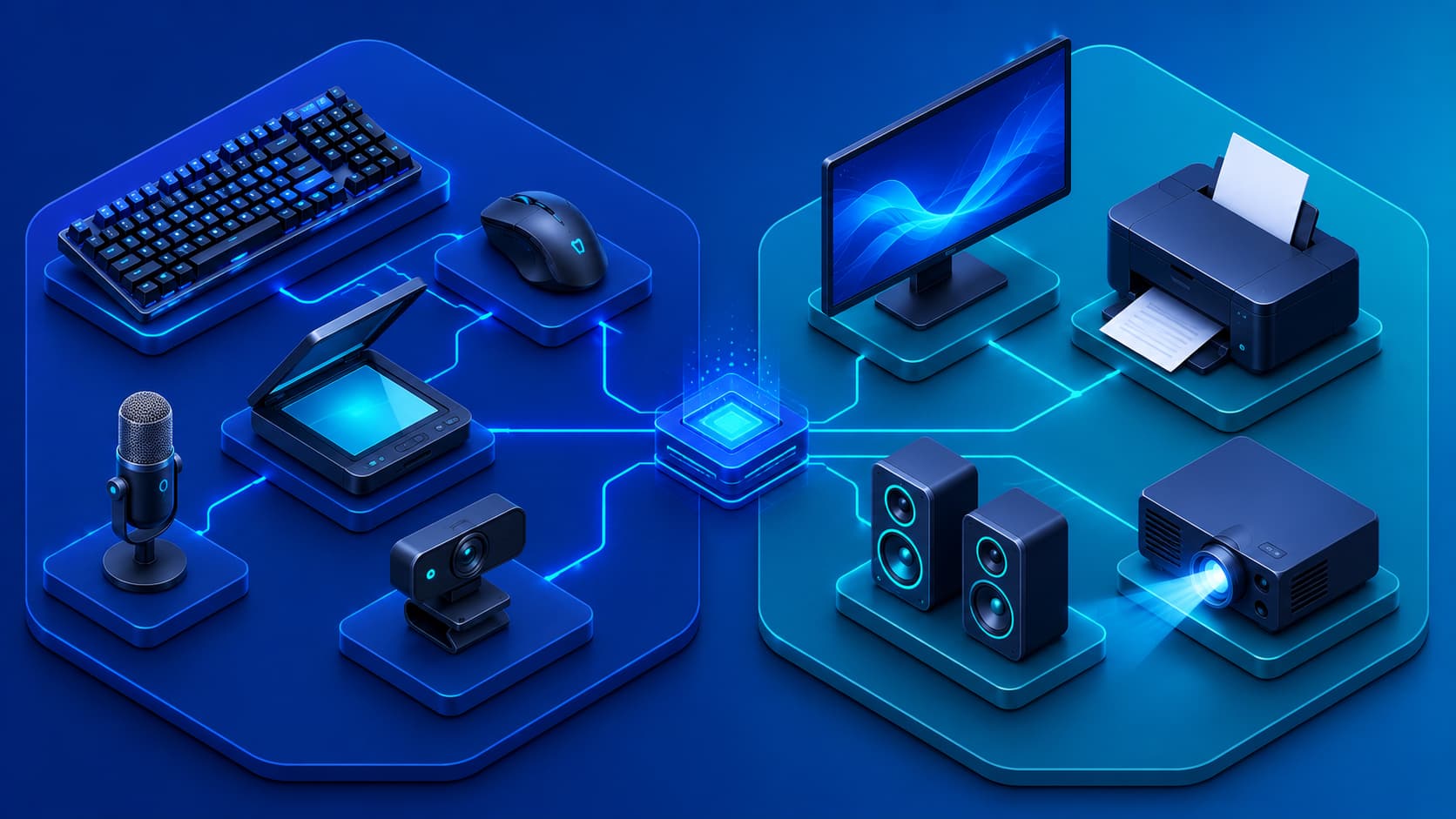
Every interaction with a computer involves the movement of information.
When you type on a keyboard, move a mouse, tap a touchscreen, or speak into a microphone, you're sending information to the computer.
When text appears on a monitor, music plays through speakers, or a printer produces a document, the computer is sending information back to you.
These two directions of communication form the basis of how people interact with digital devices.
Hardware responsible for receiving information is known as input devices.
Hardware responsible for presenting information is known as output devices.
Although they perform different roles, both are essential.
Without input devices, users couldn't communicate with computers.
Without output devices, computers couldn't display the results of their work.
Together, they create the interactive experience we expect from modern technology.
What Is an Input Device?
An input device is a hardware component that sends information or commands to a computer.
It allows users—or sometimes other systems—to provide data that software can process.
Input devices convert physical actions into digital signals that computers can understand.
For example, pressing a key on a keyboard sends a signal representing a specific character.
Moving a mouse changes the position of the cursor.
Speaking into a microphone converts sound waves into digital audio data.
Without input devices, computers would have no practical way to receive instructions from users.
What Is an Output Device?
An output device presents processed information generated by the computer.
After software performs calculations or processes data, output devices convert that information into forms people can see, hear, or physically use.
For example, monitors display text, images, and videos.
Speakers produce sound.
Printers create physical documents.
Projectors display information on large screens.
Output devices transform digital information into meaningful results that users can understand.
Why Both Types Are Important
Input and output devices work together continuously.
Imagine writing a document.
You type using a keyboard.
The keyboard sends information to the computer.
The software processes each keystroke.
The monitor immediately displays the text you've entered.
Without input devices, the document couldn't be created.
Without output devices, you wouldn't be able to see what you were writing.
Nearly every interaction with a computer follows this same pattern of receiving information, processing it, and presenting the result.
The Flow of Information
A simplified view of computer operation looks like this:
Input Device → Processing Hardware → Memory & Storage → Output Device
For example:
- You move a mouse.
- The processor interprets the movement.
- The operating system updates the cursor position.
- The monitor displays the new cursor location.
Although this process happens almost instantly, it demonstrates how multiple hardware components cooperate to create a smooth user experience.
Common Examples of Input Devices
Input devices come in many forms depending on how users interact with a computer.
Some are designed for typing, while others capture images, sound, movement, or touch.
Keyboard
The keyboard is one of the most widely used input devices.
It allows users to enter letters, numbers, symbols, and commands.
Although keyboards vary in layout and design, they all serve the same primary purpose: providing text and command input.
Mouse
A mouse controls the on-screen pointer, allowing users to select objects, open applications, drag files, and interact with graphical interfaces.
Modern mice may also include additional buttons, scroll wheels, or programmable controls.
Touchscreen
A touchscreen combines display and input capabilities into a single device.
Users interact directly with the screen by tapping, swiping, pinching, or drawing.
Touchscreens have become common on smartphones, tablets, self-service kiosks, and many modern laptops.
Microphone
Microphones capture sound and convert it into digital signals.
They are widely used for voice calls, online meetings, voice assistants, audio recording, and speech recognition.
Scanner
Scanners convert printed documents or photographs into digital images that can be stored, edited, or shared electronically.
They are commonly used in offices, schools, and document management systems.
Common Examples of Output Devices
Output devices allow computers to present processed information in forms users can understand.
Monitor
The monitor is the primary visual output device.
It displays text, graphics, videos, software interfaces, and other digital content.
Modern monitors vary in size, resolution, refresh rate, and display technology, but they all share the same purpose of presenting visual information.
Speakers
Speakers convert digital audio into sound.
They allow users to hear music, videos, notifications, voice calls, and other audio generated by software.
Printer
Printers produce physical copies of digital documents, photographs, labels, and other materials.
Although many workflows have become paperless, printers remain important in homes, schools, and businesses.
Projector
Projectors display computer output on larger surfaces, making them useful for classrooms, conference rooms, presentations, and entertainment.
Devices That Perform Both Roles
Some hardware devices function as both input and output devices.
For example:
Touchscreen Displays
A touchscreen displays information while simultaneously detecting user touches.
This dual functionality makes it both an output device and an input device.
Headsets
A headset combines headphones and a microphone.
The headphones provide audio output, while the microphone captures voice input.
Multifunction Printers
Many office printers also include scanners.
These devices print documents (output) and scan documents (input), combining two hardware functions into one product.
Input and Output in Everyday Computing
Nearly every computing task involves both input and output.
For example:
Typing an email:
- Keyboard → Input
- Processor → Processing
- Monitor → Output
Watching a movie:
- Mouse or touchscreen → Input
- Software → Processing
- Monitor and speakers → Output
Printing a report:
- Keyboard and mouse → Input
- Software → Processing
- Printer → Output
These examples demonstrate that computers continuously alternate between receiving information and presenting results.
Common Misconceptions
A Monitor Is Not an Input Device
Many beginners assume monitors are both input and output devices.
In reality, a standard monitor only displays information.
Only touchscreen displays provide input capabilities.
A Printer Doesn't Send Information to the Computer
A traditional printer only receives information from the computer.
It becomes both an input and output device only when scanning functionality is included.
Input Devices Don't Process Data
Input devices simply collect information and send it to the computer.
Processing occurs inside hardware such as the processor and memory—not within the input device itself.
Frequently Asked Questions
What is the difference between input devices and output devices?
Input devices send information to a computer, while output devices present processed information from the computer to the user.
Is a touchscreen an input or output device?
A touchscreen performs both roles.
It displays information while also detecting user touch input.
Can one device be both an input and output device?
Yes.
Examples include touchscreens, headsets, and multifunction printers that combine printing and scanning capabilities.
Why are input devices important?
Without input devices, users would have no practical way to provide commands or data to a computer.
Why are output devices important?
Output devices allow computers to communicate results by displaying text, images, audio, video, or printed documents.
Conclusion
Input devices and output devices form the foundation of human-computer interaction.
Input devices allow users to communicate with computers by providing commands and data, while output devices present the results of processing in visual, audio, or printed form.
Although they perform opposite roles, they work together continuously to create the seamless digital experiences we rely on every day.
Understanding these two categories of hardware provides an important foundation for learning more advanced computer components and how complete computing systems operate.
In the next article, we'll explore the Central Processing Unit (CPU), examining how it executes instructions, processes data, and coordinates the activities of nearly every hardware component inside a computer.