If you've ever wondered how Netflix always seems to recommend another movie you'll probably enjoy, or why your email catches spam before you even notice it, you've already experienced machine learning in action.
Most people hear the term artificial intelligence first. Then, sooner or later, another phrase appears: machine learning.
It's easy to assume they mean exactly the same thing.
They don't.
Machine learning is one of the technologies that makes modern artificial intelligence possible. It's the reason many AI systems can improve over time instead of following the same fixed instructions forever.
The idea might sound complicated, but the concept is surprisingly straightforward.
Rather than programming a computer with every possible rule, developers give it data, let it find patterns, and use those patterns to make future predictions.
That's why machine learning has become one of the most important technologies behind today's digital world.
What Is Machine Learning?
Machine learning is a branch of artificial intelligence that enables computers to learn from data without being explicitly programmed for every situation.
Traditional software follows instructions written by a developer.
Machine learning works differently.
Instead of saying:
"If this happens, do this."
Developers provide examples.
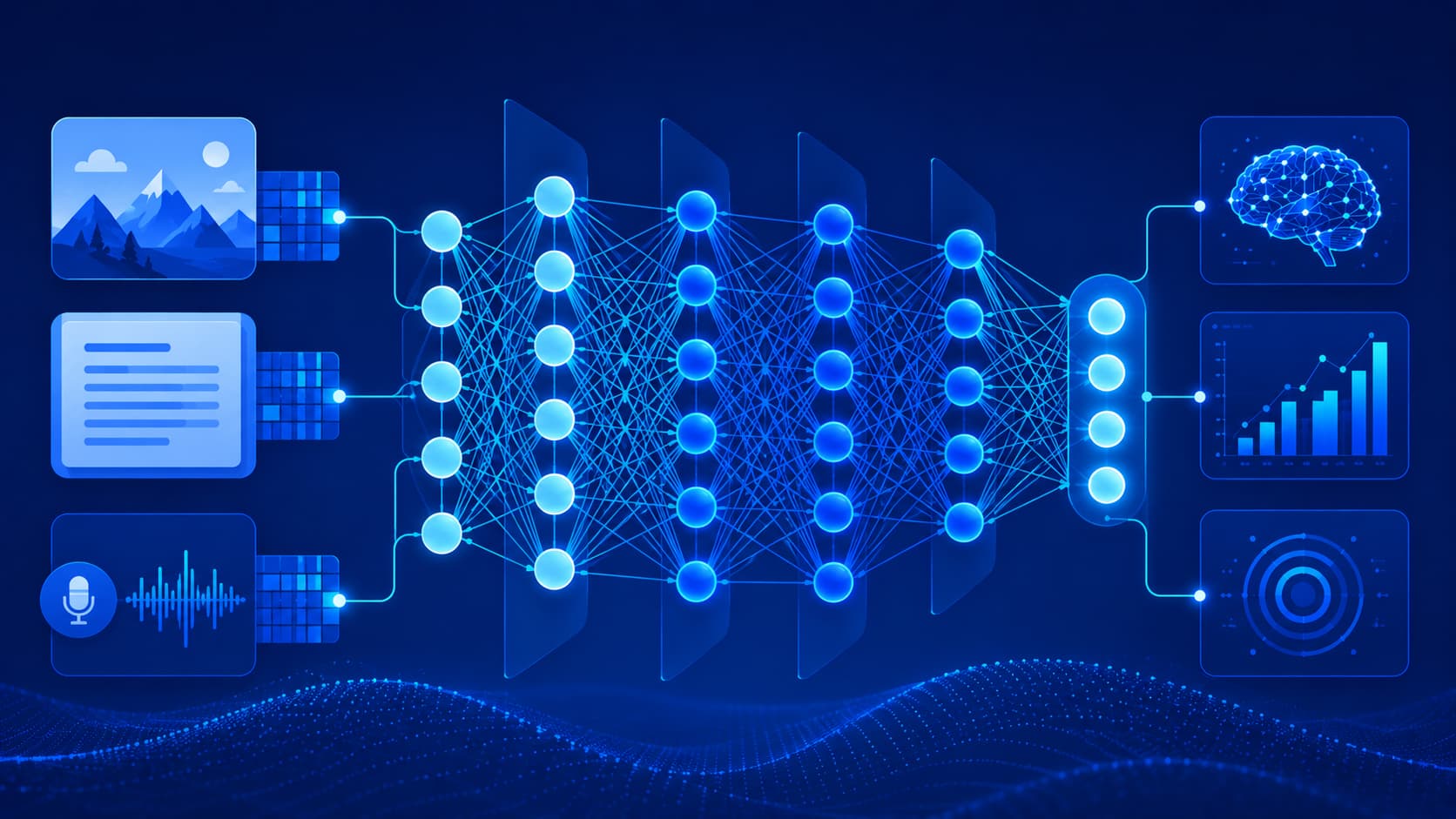
The computer studies those examples, identifies patterns, and gradually becomes better at making predictions on its own.
Think about how children learn to recognize animals.
You probably don't hand them a rulebook explaining every detail about cats and dogs.
Instead, they see enough examples that recognizing them eventually becomes second nature.
Machine learning follows a similar process.
The more useful and accurate data it receives, the better it usually becomes at recognizing similar patterns in the future.
Why Is Machine Learning So Important?
Modern technology generates an incredible amount of data every single day.
People search the web, watch videos, upload photos, shop online, send emails, and interact with thousands of digital services.
No human team could manually analyze all of that information fast enough.
Machine learning makes that possible.
It helps computers identify trends, detect unusual activity, predict future outcomes, and continuously improve their performance as new information becomes available.
Without machine learning, many of the digital services we rely on today simply wouldn't be practical.
Everyday Examples of Machine Learning
One of the easiest ways to understand machine learning is to look at where it's already being used.
When you open Spotify and discover a playlist that matches your taste surprisingly well, machine learning has likely analyzed your listening habits.
When YouTube suggests another video you'll probably watch next, it's learning from your previous viewing behavior.
Online stores recommend products based on your shopping history.
Banks monitor transactions to detect unusual activity that could indicate fraud.
Navigation apps estimate traffic conditions by analyzing information from thousands of drivers at the same time.
Even your smartphone keyboard uses machine learning to predict the next word you're likely to type.
Once you start noticing these examples, you'll realize machine learning has quietly become part of everyday life.
How Does Machine Learning Learn?
At its core, machine learning follows a surprisingly logical process.
First, developers collect data related to a specific problem.
Next, that data is used to train a machine learning model.
During training, the model searches for patterns, relationships, and similarities hidden within the data.
After enough practice, the model begins making predictions using information it has never seen before.
For example, imagine training a model to recognize apples.
Instead of describing every possible apple shape, color, and size, developers simply provide thousands of labeled photos.
Eventually, the model becomes capable of identifying apples in entirely new images with impressive accuracy.
Just like people improve with practice, machine learning models generally become more accurate as they learn from larger amounts of high-quality data.
Types of Machine Learning
One of the reasons machine learning can solve so many different problems is that there isn't just one way for it to learn.
Depending on the goal, developers use different learning methods. Some require labeled data, while others allow the computer to discover patterns on its own.
The three most common types of machine learning are supervised learning, unsupervised learning, and reinforcement learning.
Supervised Learning
Supervised learning is the most widely used approach.
In this method, the model learns from data that already includes the correct answers.
Imagine a teacher handing students a workbook where every question already has the answer printed in the back. As students practice, they begin to recognize patterns and eventually solve similar questions without looking at the answers.
Machine learning works in much the same way.
For example, if developers want a model to recognize dogs, they feed it thousands of images already labeled "dog." Over time, the model learns what features dogs have in common and can recognize new images it has never seen before.
This type of learning is commonly used for:
- Email spam detection
- Medical diagnosis support
- Image recognition
- Credit risk analysis
- Weather forecasting
Unsupervised Learning
Unsupervised learning takes a different approach.
Instead of giving the computer the correct answers, developers simply provide large amounts of data and let the model discover hidden patterns on its own.
Think about walking into a library where none of the books are organized.
After looking through enough titles, authors, and subjects, you naturally begin grouping similar books together.
That's essentially what unsupervised learning does.
It's especially useful when nobody knows exactly what patterns exist within the data.
Businesses often use this method to group customers with similar buying habits, helping them create more personalized marketing campaigns.
Reinforcement Learning
Reinforcement learning is based on trial and error.
Instead of learning from examples, the model learns by making decisions and receiving feedback.
Good decisions are rewarded.
Poor decisions receive a penalty.
Over time, the model discovers which actions lead to the best outcome.
A good example is teaching a child to ride a bicycle.
They don't learn from reading instructions alone.
They try, fall, adjust, and improve with every attempt.
Eventually, riding becomes natural.
AI systems use reinforcement learning in a similar way.
This technique has been used in robotics, autonomous driving research, and even AI systems capable of defeating world champions in complex strategy games.
Machine Learning vs Traditional Programming
Understanding the difference between machine learning and traditional programming helps explain why AI has become so powerful.
Traditional software relies on rules written by developers.
If developers forget to include a rule, the software won't know how to respond.
Machine learning works differently.
Instead of relying entirely on manually written instructions, developers provide data and let the model discover the rules for itself.
You can think of it like this:
Traditional programming is similar to following a recipe step by step.
Machine learning is more like learning to cook through experience.
The more recipes you prepare, the better you become at understanding flavors, ingredients, and techniques—even without reading every instruction.
That's why machine learning performs especially well when dealing with problems that involve huge amounts of data or constantly changing conditions.
Challenges of Machine Learning
Machine learning has achieved remarkable progress, but it's far from perfect.
Like any technology, it comes with challenges that developers must address.
Data Quality
Machine learning models depend heavily on the quality of their training data.
If the data is incomplete, outdated, or biased, the model's predictions can also become inaccurate.
This is why collecting clean and representative data is often one of the most time-consuming parts of building an AI system.
Bias
AI doesn't create opinions of its own.
It learns from data created by people.
If that data contains bias, the model may unintentionally repeat or even amplify those patterns.
Developers work continuously to reduce these issues, but eliminating bias entirely remains an ongoing challenge across the AI industry.
Privacy
Many machine learning systems rely on large amounts of user data.
That raises important questions about how information is collected, stored, and protected.
As AI becomes more common, privacy and responsible data handling will continue to play a major role in building public trust.
The Future of Machine Learning
Machine learning has already transformed how people interact with technology, and its influence is only expected to grow.
In the years ahead, we'll likely see machine learning become even more integrated into everyday products rather than existing as a separate feature.
Healthcare systems may diagnose diseases more quickly.
Educational platforms could adapt lessons to every student's learning style.
Businesses may automate routine tasks even further, allowing employees to focus on more creative and strategic work.
For most people, the biggest change won't be using more AI applications.
It will be realizing that many of the apps they already use have quietly become smarter because of machine learning.
Key Takeaways
- Machine learning is a branch of artificial intelligence that learns from data.
- Unlike traditional software, machine learning improves by identifying patterns instead of following fixed rules.
- The three main types of machine learning are supervised, unsupervised, and reinforcement learning.
- Many everyday services—including streaming platforms, navigation apps, spam filters, and recommendation systems—rely on machine learning.
- High-quality data is essential for building accurate and reliable models.
- Machine learning continues to shape the future of healthcare, education, business, and countless other industries.
Frequently Asked Questions
Is machine learning the same as artificial intelligence?
No. Artificial intelligence is the broader field, while machine learning is one of the technologies used to build AI systems.
Do machine learning systems keep learning forever?
Not automatically.
Many models need to be retrained with new data to maintain their accuracy as conditions change over time.
Do I need to know programming to understand machine learning?
No.
Understanding the basic concepts doesn't require programming knowledge.
However, programming becomes important if you want to build machine learning models yourself.
Why is data so important in machine learning?
Machine learning learns by analyzing examples.
The quality of those examples directly affects how accurate and reliable the model becomes.
Is machine learning used only by technology companies?
Not at all.
Today, industries such as healthcare, finance, manufacturing, transportation, education, agriculture, and retail all use machine learning in different ways.
Conclusion
Machine learning is one of the technologies that has made today's AI revolution possible.
Every time an app recommends something you might like, detects suspicious activity, predicts traffic conditions, or helps you find information faster, there's a good chance machine learning is working behind the scenes.
While the technology may sound complex at first, its core idea is surprisingly simple: learn from data, recognize patterns, and use those patterns to make better decisions.
You don't need to become a data scientist to appreciate how machine learning works.
Simply understanding the basics gives you a clearer picture of why AI has advanced so quickly—and why it will continue to shape the technology we use every day.