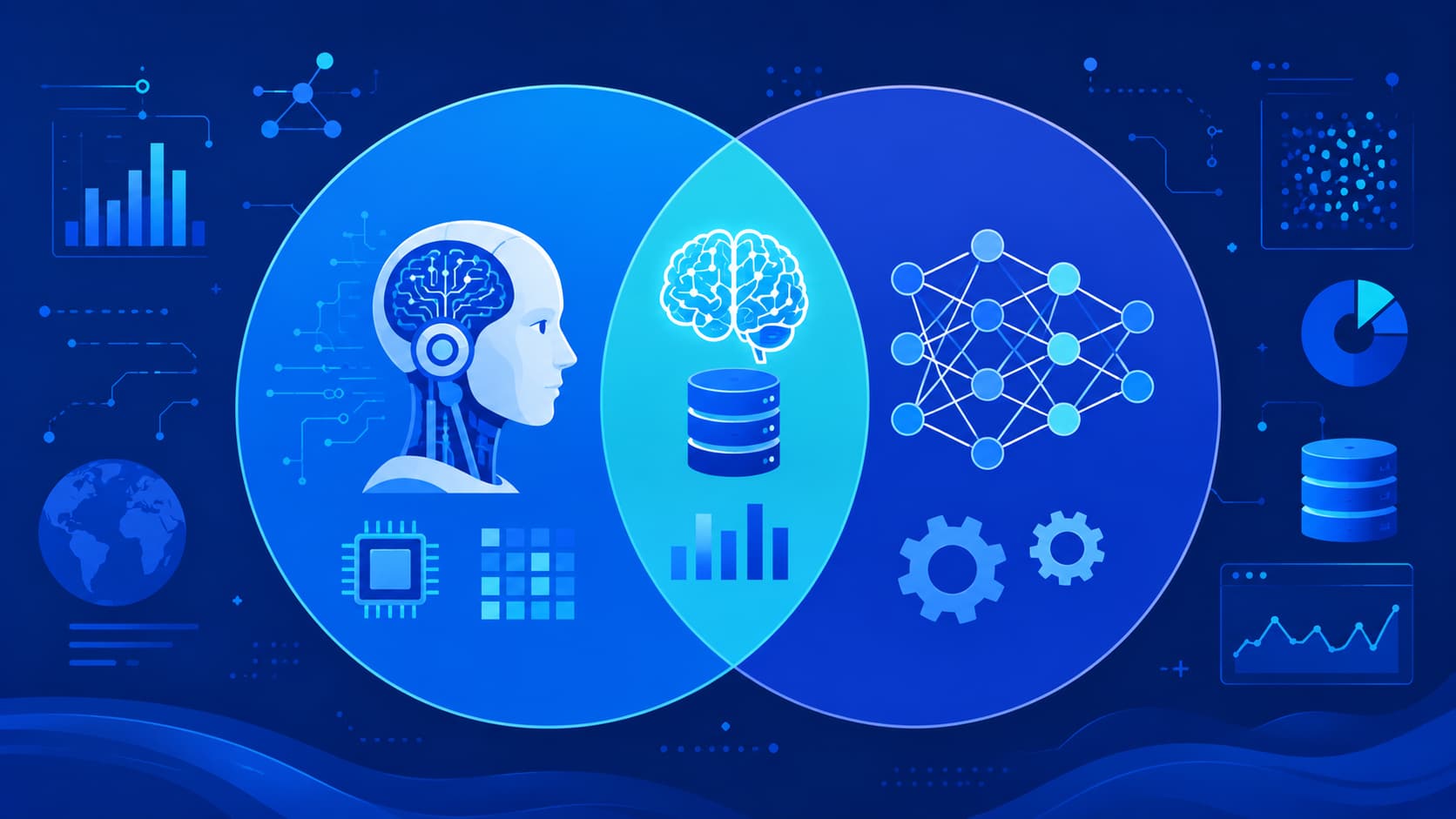
If you've been reading about artificial intelligence for a while, you've probably noticed something confusing.
Some articles talk about AI.
Others talk about machine learning.
Sometimes they seem to mean the same thing.
Other times they sound completely different.
It's no surprise that many beginners assume they're interchangeable.
The truth is much simpler.
Machine learning and artificial intelligence are closely connected, but they describe different things.
A helpful way to think about it is this:
Artificial intelligence is the destination.
Machine learning is one of the roads that leads there.
Once you understand that relationship, many AI concepts suddenly become much easier to follow.
What Is Artificial Intelligence?
Artificial intelligence is the broader field.
Its goal is to build computer systems capable of performing tasks that normally require human intelligence.
These tasks include understanding language, recognizing images, solving problems, making decisions, translating text, generating content, and much more.
AI isn't a single technology.
Instead, it's a collection of ideas, methods, and technologies working together to create intelligent systems.
That's why you'll often hear terms like machine learning, deep learning, computer vision, and natural language processing when discussing AI.
They're all pieces of the same puzzle.
What Is Machine Learning?
Machine learning is one of those pieces.
Rather than programming every rule manually, developers train computers using data.
The system studies examples, identifies patterns, and gradually improves its ability to make predictions.
Imagine trying to teach someone how to recognize apples.
Instead of writing a detailed instruction manual describing every possible apple, you simply show hundreds or thousands of examples.
Eventually, they begin recognizing apples they've never seen before.
Machine learning follows the same principle.
It learns from experience rather than relying entirely on explicit instructions.
The Relationship Between AI and Machine Learning
One of the easiest mistakes to make is assuming that AI and machine learning are separate technologies competing with each other.
They're not.
Machine learning exists inside artificial intelligence.
Every machine learning system is part of AI.
However, not every AI system relies on machine learning.
You can picture it as a large circle with a smaller circle inside it.
The larger circle represents artificial intelligence.
Inside that circle sits machine learning.
And inside machine learning sits another specialized field called deep learning.
This hierarchy explains why the terms often appear together in articles and discussions.
They're connected, but they're not identical.
Why Do People Confuse the Two?
The confusion mostly comes from how rapidly AI has evolved over the last decade.
Machine learning has become so successful that many modern AI applications depend on it.
As a result, news articles often use the two terms interchangeably.
For example, when someone says,
"AI recommended this movie."
What actually made the recommendation was most likely a machine learning model.
The recommendation system is part of an AI application, while machine learning is the technology that helps it improve over time.
It's a subtle difference, but an important one.
Once you recognize it, discussions about AI become much easier to understand.
The Key Differences Between Artificial Intelligence and Machine Learning
Although the two terms are closely related, they have different goals.
Artificial intelligence focuses on creating systems that can perform tasks requiring human-like intelligence.
Machine learning focuses on giving those systems the ability to learn from data instead of relying only on predefined rules.
Another way to think about it is like running a business.
Artificial intelligence represents the entire company.
Machine learning is one of the departments that helps the company achieve its goals.
Without the company, the department wouldn't exist.
Without the department, however, the company could still operate using different methods.
That's essentially how AI and machine learning relate to one another.
AI vs Machine Learning: A Side-by-Side Comparison
Sometimes the easiest way to understand a concept is to compare it directly.
| Artificial Intelligence | Machine Learning |
|---|---|
| A broad field of computer science | A branch of artificial intelligence |
| Focuses on building intelligent systems | Focuses on learning from data |
| Includes multiple technologies | One of the technologies within AI |
| May or may not use machine learning | Always belongs to AI |
| Covers reasoning, planning, language, vision, robotics, and more | Primarily focused on recognizing patterns and making predictions |
The important thing to remember is that machine learning isn't an alternative to AI.
It's one of the technologies that allows AI to become smarter.
Real-World Examples
The relationship becomes much clearer when you look at everyday technology.
Imagine opening Netflix after work.
The application itself is part of a larger AI system designed to personalize your experience.
Behind the scenes, a machine learning model studies what you've watched before, how long you watched it, what you skipped, and what people with similar interests enjoyed.
Using those patterns, it recommends your next movie.
The same idea appears in many other services.
A navigation app predicts traffic conditions.
A bank detects unusual transactions.
A shopping website recommends products.
An email service filters spam.
In each case, artificial intelligence is the overall solution, while machine learning provides the ability to learn from data and improve over time.
Where Does Deep Learning Fit In?
If you've already heard about deep learning, you might be wondering where it belongs.
Think of the relationship as three layers.
Artificial intelligence is the largest field.
Inside AI is machine learning.
Inside machine learning is deep learning.
Deep learning uses artificial neural networks with multiple layers to solve more complex problems.
It's the technology behind many of today's most impressive AI breakthroughs, including image generation, speech recognition, language translation, and modern AI assistants.
You don't need to master deep learning to understand AI.
Just knowing where it fits makes the overall picture much easier to understand.
Which One Should You Learn First?
If you're just getting started, begin with artificial intelligence.
Understanding the bigger picture first makes everything else easier to connect.
Once you're familiar with AI, move on to machine learning.
After that, explore deep learning, generative AI, prompt engineering, or any other area that matches your interests.
Trying to learn everything at once often creates unnecessary confusion.
Building your knowledge step by step is a much more effective approach.
Common Misconceptions
One misconception is that AI became popular only after tools like ChatGPT appeared.
In reality, artificial intelligence has existed for decades.
What changed is that recent advances in machine learning and deep learning made AI far more practical and accessible.
Another common misunderstanding is that every AI system automatically learns from experience.
That's not always true.
Some AI systems rely on fixed rules rather than learning from new data.
Machine learning is what gives many modern AI systems the ability to improve through experience.
Finally, some people believe learning machine learning automatically means understanding artificial intelligence.
Machine learning is an important part of AI, but it's only one piece of a much larger field that also includes robotics, computer vision, natural language processing, reasoning, planning, and many other disciplines.
Frequently Asked Questions
Is machine learning a type of artificial intelligence?
Yes.
Machine learning is one of the main branches of artificial intelligence and is used to help computers learn from data instead of relying entirely on manually programmed rules.
Can artificial intelligence exist without machine learning?
Yes.
Some AI systems use predefined rules instead of learning from data.
While machine learning powers many modern AI applications, it's not the only approach to building intelligent systems.
Which should I learn first, AI or machine learning?
Start by understanding the basics of artificial intelligence.
Once you understand the overall field, learning machine learning becomes much easier because you'll see how it fits into the bigger picture.
Is deep learning the same as machine learning?
No.
Deep learning is a specialized branch of machine learning that uses multi-layered neural networks to solve more complex problems.
Why do people use the terms interchangeably?
Because many modern AI applications rely heavily on machine learning, the two terms are often mentioned together in news articles and marketing materials.
Although they're closely connected, they don't have the same meaning.
Conclusion
Artificial intelligence and machine learning are closely connected, but they're not interchangeable.
Artificial intelligence is the broader goal of creating systems that can perform tasks requiring human intelligence.
Machine learning is one of the most important technologies that helps achieve that goal by allowing computers to learn from data.
Understanding this relationship makes it much easier to follow discussions about modern technology, evaluate new AI tools, and continue learning more advanced topics in the future.
As AI continues to evolve, you'll encounter many new terms and technologies.
Remembering one simple idea—that machine learning is part of artificial intelligence—will give you a solid foundation for understanding everything that comes next.