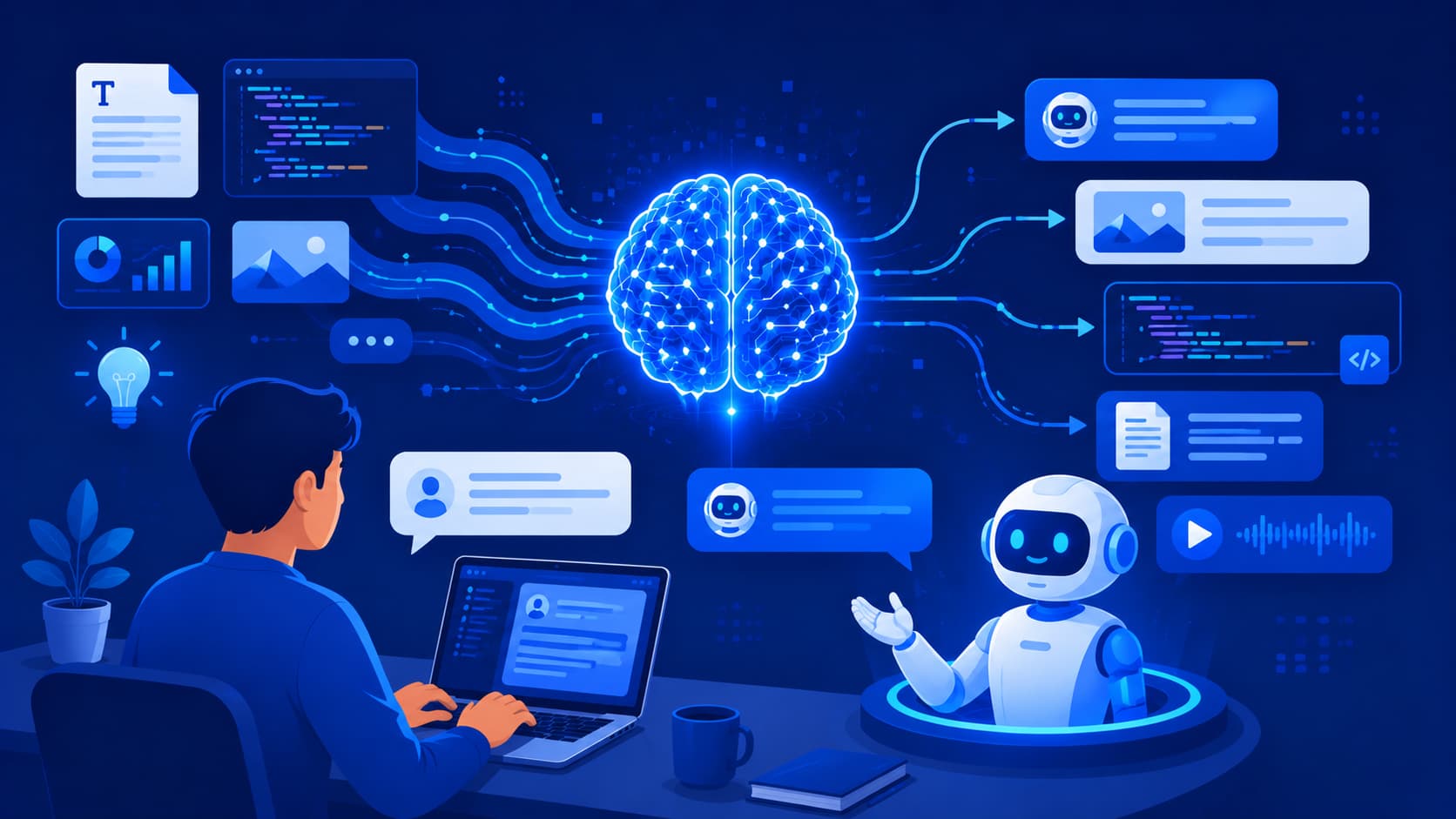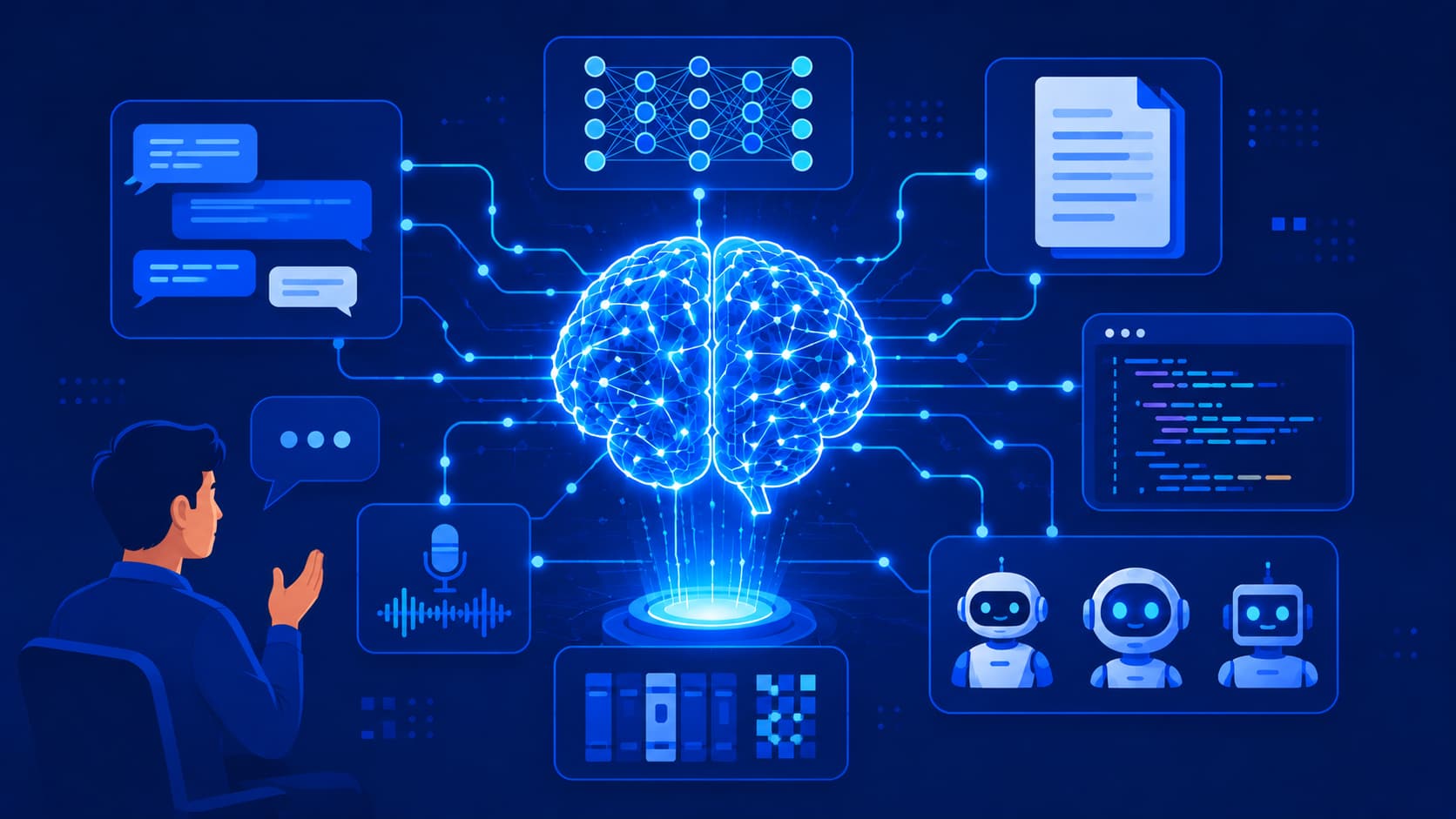
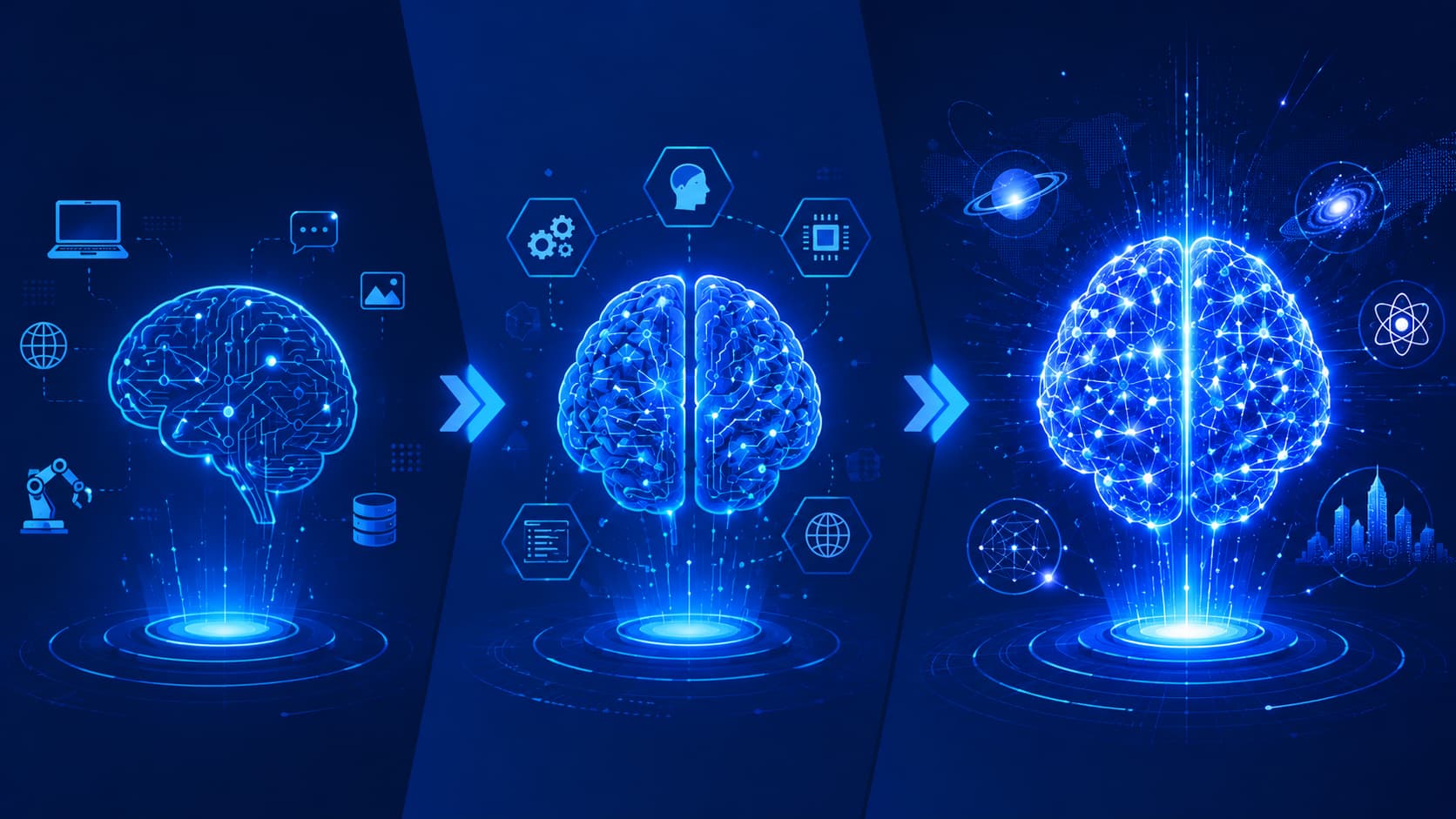
When people talk about artificial intelligence, they often speak as if it's one single technology.
In reality, AI is a broad field that includes different levels of intelligence and different capabilities.
That's why you'll often hear terms like Narrow AI, General AI, or even Super AI. At first, those names can sound intimidating, but the ideas behind them are actually quite simple.
The easiest way to think about AI is to imagine a scale.
On one end, you have AI that's designed to do one specific job extremely well. On the other end, you have theoretical AI that's capable of learning and reasoning like a human—or even beyond human intelligence.
Today, almost every AI tool you use belongs to the first category.
Understanding these different types of AI makes it much easier to separate what's already possible from what's still part of future research.
Why Is AI Divided into Different Types?
Not every AI system is built for the same purpose.
Some are designed to recognize faces.
Others translate languages, recommend products, generate images, or answer questions.
Although they all fall under the umbrella of artificial intelligence, their capabilities are very different.
Researchers classify AI into different categories to describe how flexible and intelligent a system actually is.
This helps explain why your phone's voice assistant can't suddenly become a doctor, and why an AI chatbot can't instantly learn how to fly an airplane.
Each system is created with specific goals and limitations.
Understanding those limitations is just as important as understanding what AI can do.
Narrow AI
Narrow AI, also known as Weak AI, is the only type of artificial intelligence that exists today.
Despite the name, there's nothing "weak" about it.
In fact, Narrow AI can outperform humans in very specific tasks.
For example, an AI model trained to identify skin cancer from medical images may detect patterns that are difficult for the human eye to notice.
Another AI system might process millions of financial transactions to identify fraud in real time.
Both are incredibly capable—but only within the tasks they were designed to perform.
Ask that same medical AI to write a poem or recommend a movie, and it won't know where to begin.
That's the defining characteristic of Narrow AI.
It excels at one job, but it can't move beyond that job without being trained again.
Many of the AI tools people use every day fall into this category, including:
- ChatGPT
- Google Gemini
- Microsoft Copilot
- Google Translate
- Siri
- Alexa
- Face ID
- Netflix recommendations
- Spotify recommendations
Even though these tools can feel impressively intelligent, they're still examples of Narrow AI because each one has a specific purpose.
General AI
If Narrow AI is designed to solve one specific problem, General AI would be able to solve almost any intellectual problem a human can.
Imagine asking an AI assistant to write an email in the morning, diagnose a technical issue in the afternoon, learn to play a new musical instrument in the evening, and help plan a business strategy before bed—all without needing separate training for each task.
That's the idea behind General AI.
Unlike today's AI systems, General AI wouldn't be limited to one specialty. It could understand new situations, apply knowledge from one area to another, and continue learning much like a person does throughout life.
It's an exciting concept, but it's important to separate expectation from reality.
Despite what headlines sometimes suggest, General AI doesn't exist today.
Researchers around the world continue exploring the possibility, but current AI systems are still designed for specific purposes rather than broad human-like intelligence.
For now, General AI remains a long-term research goal rather than a real product you can use.
Superintelligent AI
Beyond General AI lies an even more ambitious idea: Superintelligent AI.
This refers to a hypothetical system that would outperform humans in virtually every intellectual activity.
It could potentially solve scientific problems faster than researchers, design new technologies, discover medical treatments, and make decisions based on an enormous amount of information in seconds.
Because no such system exists, much of the discussion around Superintelligent AI belongs to philosophy, ethics, and future planning rather than practical technology.
Some experts see it as a possibility worth preparing for.
Others believe it's still far too early to predict whether it will ever become reality.
Either way, it's useful to understand that Super AI is a theoretical concept—not something available today.
Another Way to Classify Artificial Intelligence
You've probably noticed that AI is often divided into Narrow AI, General AI, and Super AI.
That's the most common classification because it focuses on intelligence and capability.
However, researchers also classify AI based on how it functions.
This second approach is less familiar to most people, but it's worth understanding because you'll often encounter these terms in books, research papers, and technology news.
Reactive Machines
Reactive Machines are the simplest type of AI.
They respond only to the information available at the present moment and don't remember previous experiences.
A famous example is IBM's Deep Blue, the chess computer that defeated world chess champion Garry Kasparov in 1997.
Deep Blue could analyze millions of possible chess moves, but it couldn't learn from previous matches or remember past games.
Every move was calculated from scratch.
Limited Memory AI
Limited Memory AI is far more common today.
These systems can use recent information to improve their decisions.
For example, a navigation app remembers current traffic conditions before suggesting the fastest route.
Similarly, modern AI chatbots use the recent conversation to generate more relevant responses.
Most AI tools available today—including recommendation systems, self-driving vehicle research, and generative AI—fall into this category.
Theory of Mind AI
Theory of Mind AI is still a research concept.
The goal is to build AI capable of understanding emotions, intentions, beliefs, and social interactions in a way that's closer to human communication.
Although researchers continue exploring this idea, today's AI systems don't truly understand human emotions.
They recognize patterns in language rather than experiencing feelings themselves.
Self-Aware AI
Self-Aware AI represents the most advanced theoretical stage.
In theory, such a system would possess consciousness, self-awareness, and an understanding of its own existence.
This type of AI exists only in science fiction and philosophical discussions.
There is currently no evidence that modern AI systems possess consciousness or self-awareness.
Comparing the Main Types of AI
Understanding the differences becomes much easier when viewed side by side.
| Type | Exists Today? | Main Capability |
|---|---|---|
| Narrow AI | Yes | Performs specific tasks exceptionally well |
| General AI | No | Can learn and perform any intellectual task similar to humans |
| Superintelligent AI | No | Surpasses human intelligence across nearly every field |
For most people, Narrow AI is the only category they'll interact with in everyday life.
The other two remain ideas that researchers continue to explore.
Common Misconceptions
Because AI develops so quickly, it's easy for misconceptions to spread.
One common belief is that ChatGPT or similar AI assistants are examples of General AI.
They're not.
Although these systems can answer questions, write code, summarize documents, and hold conversations, they're still examples of Narrow AI because they're designed for specific purposes.
Another misconception is that Super AI is just around the corner.
In reality, nobody knows when—or even if—technology will reach that point.
Current AI has made impressive progress, but there's still a significant gap between today's systems and the concepts of General or Superintelligent AI.
Understanding these distinctions helps separate realistic expectations from science fiction.
Why Understanding AI Types Matters
Knowing the different types of AI isn't just useful for students or technology enthusiasts.
It also helps you evaluate the claims you see in news articles, social media posts, and product announcements.
When a company says its software uses artificial intelligence, you'll have a better idea of what that actually means.
More often than not, they're referring to Narrow AI—a system trained to solve a specific problem rather than a machine capable of thinking like a human.
That understanding makes it easier to cut through marketing buzzwords and recognize what today's AI can realistically accomplish.
Frequently Asked Questions
What type of artificial intelligence exists today?
Almost every AI system available today is an example of Narrow AI. These systems are designed to perform specific tasks, such as generating text, recognizing images, or recommending content.
Is ChatGPT a General AI?
No. ChatGPT is considered Narrow AI because it's designed for specific language-related tasks, even though it can perform many of them very well.
Will General AI become reality?
Researchers continue working toward General AI, but there's no clear timeline for when—or if—it will be achieved.
Is Super AI real?
No. Superintelligent AI is currently a theoretical concept and doesn't exist today.
Why are there different ways to classify AI?
One classification focuses on an AI system's capabilities, while another focuses on how the system functions. Both approaches help explain different aspects of artificial intelligence.
Conclusion
Artificial intelligence isn't a single technology with a single level of intelligence.
Instead, it covers a wide range of systems with different capabilities and purposes.
Today, every AI tool we interact with—from virtual assistants to recommendation engines—belongs to the category known as Narrow AI.
General AI and Superintelligent AI remain ideas that inspire research and shape discussions about the future, but they aren't technologies we use today.
Understanding these distinctions makes it much easier to follow developments in AI without getting caught up in exaggerated headlines or unrealistic expectations.
As artificial intelligence continues to evolve, knowing what today's systems can—and can't—do will help you make better decisions about the technology becoming part of everyday life.